
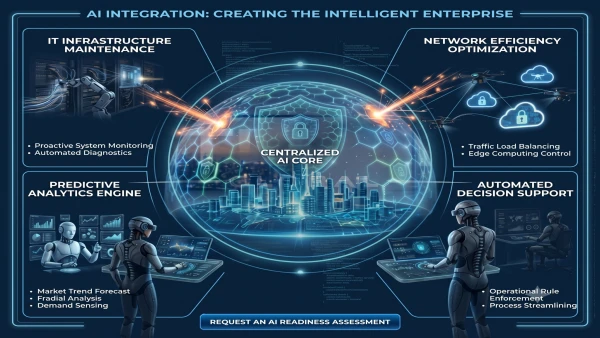
In today’s hyper-competitive digital landscape, artificial intelligence has ceased to be an isolated R&D experiment. It has evolved into the central operating nervous system for modern enterprise scale. Organizations no longer deliberate on whether to adopt AI, but rather how resiliently and securely they can integrate it into mission-critical pipelines.
"The next decade will not belong to companies that simply generate answers with AI, but to enterprises that securely operationalize autonomous decisions across hybrid architectures."
By shifting away from fragmented tools toward unified cognitive architectures, businesses unlock unprecedented speed, near-instant regulatory alignment, and proactive risk mitigation. Below is the actionable architecture behind this enterprise transformation.
Intelligent Automation Beyond Basic RPA
First-generation Robotic Process Automation (RPA) followed strict if-then rules. If an invoice format deviated by two millimeters or a field was renamed, the script failed. Contemporary Intelligent Process Automation (IPA) blends generative reasoning, semantic OCR, and micro-orchestration to navigate real-world ambiguity.
Unstructured Ingestion
Autonomous processing of messy PDF contracts, customs declarations, and vendor invoices without templates.
Dynamic Triage
AI agents parse inbound incident tickets and prioritize escalations according to sentiment, SLA, and customer impact.
Human-in-the-Loop
Routine 95% of tasks execute autonomously; low-confidence outliers route seamlessly to human auditors.
Real-Time Predictive Analytics & Proactive Decision-Making
Legacy business intelligence (BI) generated rear-view mirrors—reporting what failed last month. Modern operational AI acts like an autonomous navigational radar, projecting probable future bottlenecks, financial shifts, and inventory strains in real time.
Continuous telemetry monitors geopolitical events, weather disruptions, and supplier lead times, automatically rerouting logistical orders prior to stockouts.
Predictive telemetry auto-scales Kubernetes clusters and database nodes moments before forecasted transaction spikes, trimming up to 35% in wasted cloud spend.
The Security Imperative: Defending the AI-Driven Perimeter
As enterprises connect Large Language Models (LLMs) and autonomous agents into production ERPs and databases, the threat surface magnifies. AI cannot be implemented without a synchronized, modern cybersecurity framework.
AI-Native Threat Detection & Autonomous Remediation
Machine learning algorithms establish dynamic behavior baselines, identifying unauthorized lateral movement and isolating compromised microservices within milliseconds.
Zero Trust & Adaptive Identity Governance
Contextual access controls evaluate agent identity, token scopes, and data access patterns continuously. Prompt injection and data poisoning attacks are flagged before execution.
Continuous DevSecOps Validation
Automated security policies and static analysis inspect autonomous pipelines before deployment to prevent model evasion vulnerabilities and unauthenticated API leakage.
Operational Shifts Across the Enterprise
The transition from legacy mechanisms to AI-augmented workflows touches all functional pillars of the organization:
| Domain | Traditional Approach | AI-Powered Transformation |
|---|---|---|
| IT & SecOps | Periodic vulnerability scans and manual alert triage. | Continuous security validation with autonomous threat containment. |
| Customer Support | Static FAQ bots with fixed decision-trees. | Context-aware cognitive agents providing 24/7 hyper-personalized resolutions. |
| DevOps & Cloud | Manual provisioning and post-release security reviews. | Policy-as-code automation and real-time autonomous performance tuning. |
| Procurement | Batch spreadsheets and multi-week invoice matching. | Zero-touch matching, automated anomaly checks, and vendor risk scoring. |
Blueprint for Secure & Scalable AI Adoption
Deploying AI without architectural rigor introduces technical debt and compliance vulnerabilities. Follow this structured Atloen Global roadmap:
Establish Strict Data Governance & RBAC
Embed Security Directly Into the Pipeline (DevSecOps)
Target High-Impact, High-Friction Proofs-of-Value
- Autonomous vs. Scripted: Intelligent Process Automation handles messy real-world variations that break traditional RPA.
- Proactive Forecasting: Real-time predictive telemetry anticipates supply disruptions and resource spikes before they affect customers.
- Security-First Mindset: Scaling AI safely demands Zero Trust access governance, continuous auditability, and DevSecOps pipelines.